

Another Year
Wandering like a star.

I’m late. It was last March that Pietro Lorenzetti’s Birth of the Virgin (1335-42) arrived in London and we peered into a room swaddled in cloth where Anna rests enormous after pushing. Gold presses against the windows. Space is tight.
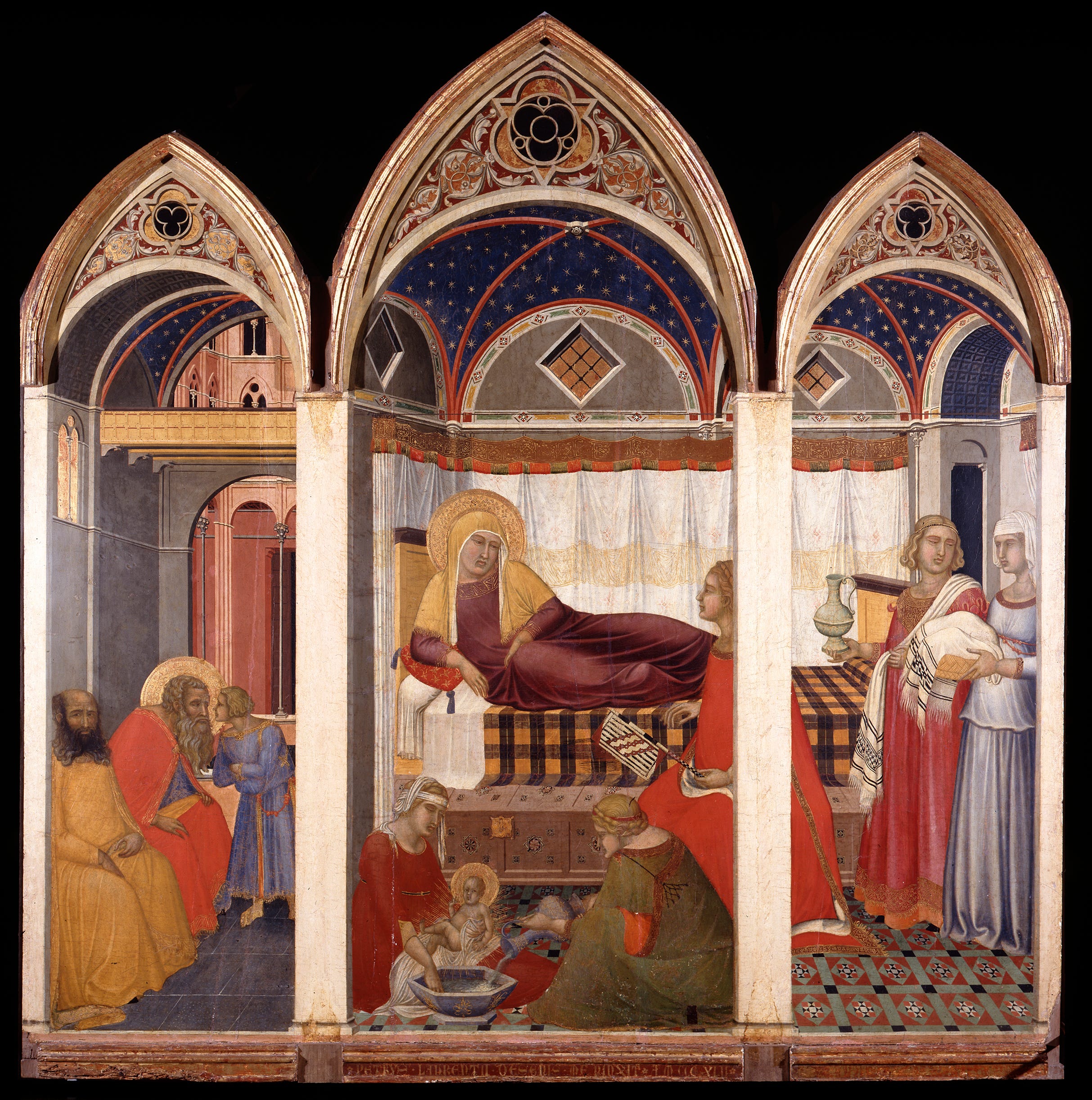
In a narrow corridor, on a separate panel, Joachim is the last to know the news. He leans forward to hear of the miracle: “The desert has greened,” proclaims John of Damascus, “The woman who was sterile has born her fruit.”1
The Immaculate Virgin Mary baby, blessing us as she waits for a bath, was born under a ceiling painted with stars.
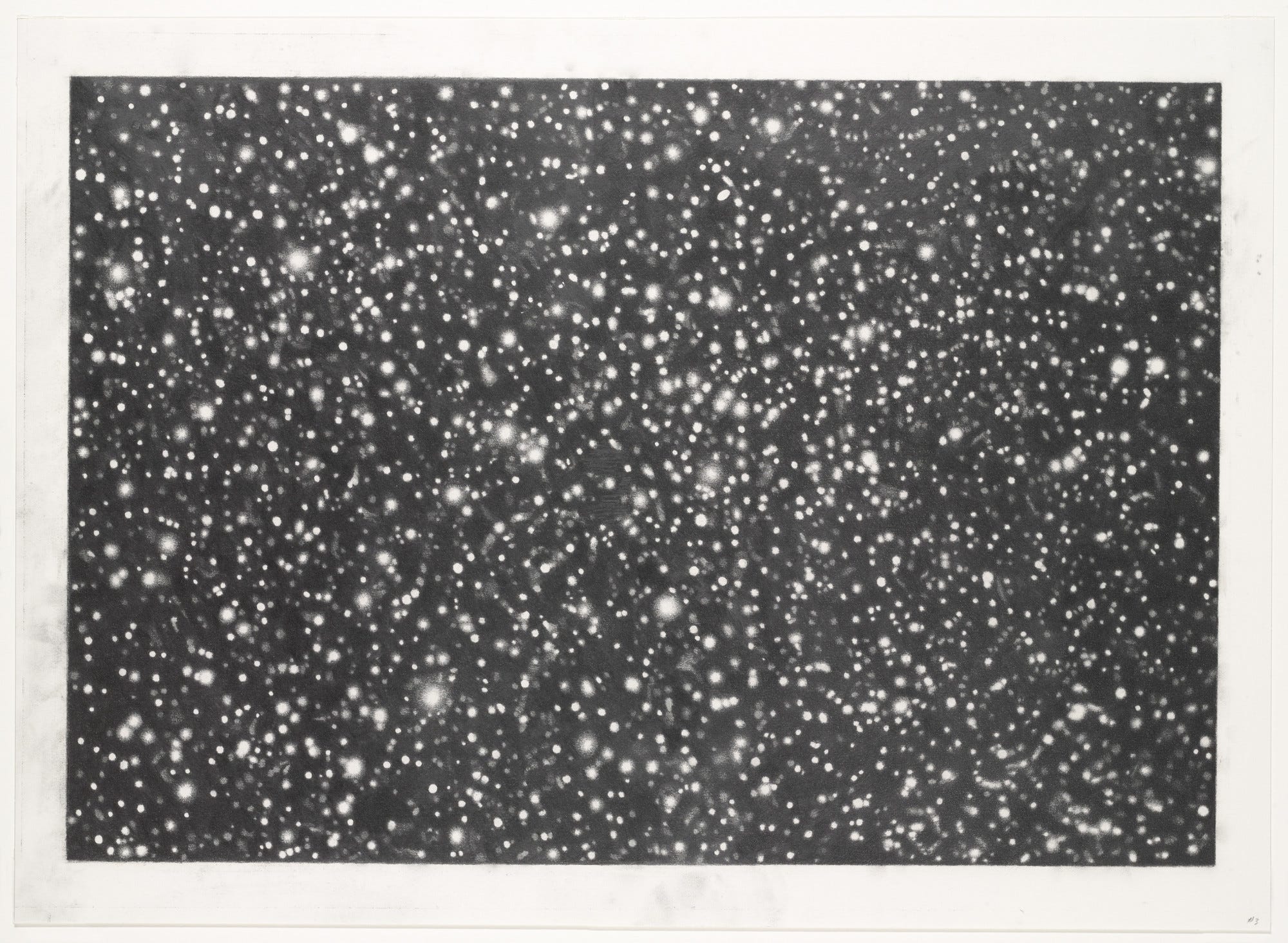
Stars covered the walls of the Vija Celmins retrospective in Basel that ran through the summer. In Star Field III (1982-83), Celmins draws a brimming graphite sky. The stars in this field are spots she’s left untouched. One has the feeling of bobbing in space. Of the celestial bodies being too close. This Celmins achieves by working from telescopic photographs, even naming some of her paintings after the astrograph.
Telescopic painting began (they say) with Adam Elsheimer’s Flight into Egypt (1609). The Virgin Mary, now grown, a mother and wife, finds her way through the constellated night.
If Celmins wants to remove order from the cosmos, it is found again in the concentric circles of Menhat Helmy’s Space Exploration/Universe (1973), which I came across at the end of the year in Mumbai. At work in Cairo, Helmy, like Celmins, kept returning to the stars.
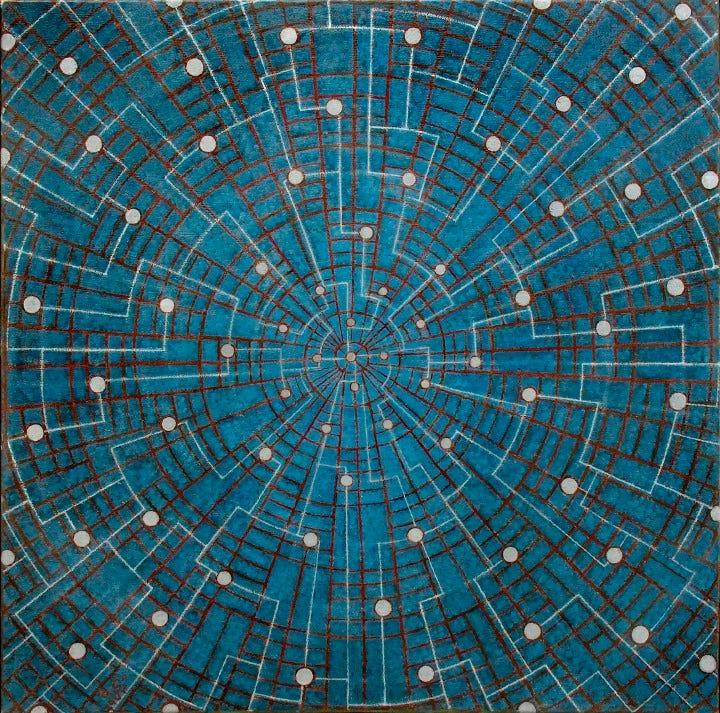
Every point is fixed in this dome. We are held in a net — as the canvases are, in a mesh of stockings, in Klodin Erb’s Nudes series that was on show at the Aargauer Kunsthaus in Aarau.
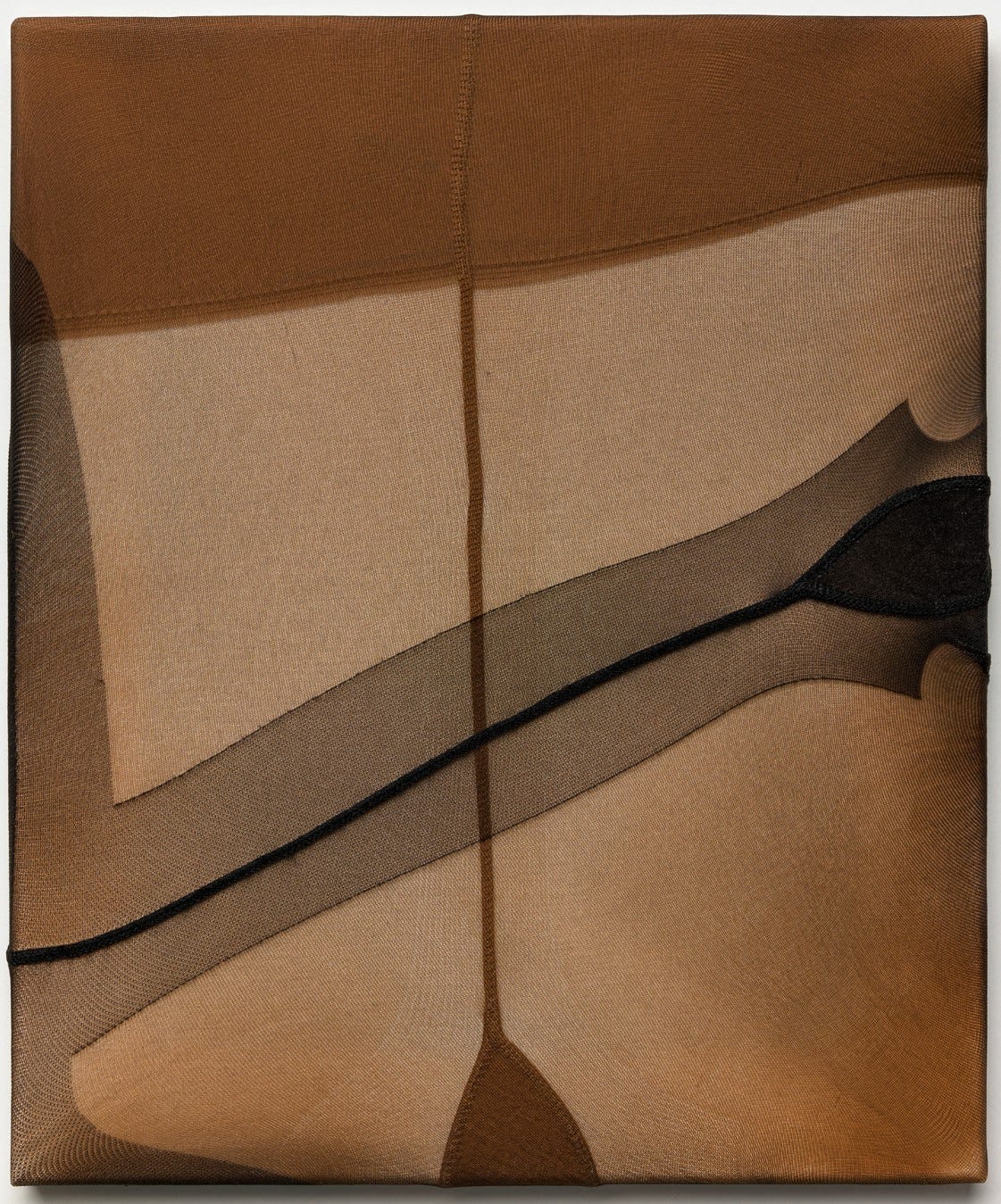
Erb layers nylon over nylon; gussets are pulled onto new paths.
More for a swim in the glacial waters of the Thunersee than any exhibition, I spent a summer’s day in Spiez. In the castle there was Marguerite Frey-Surbek’s Faulhorn. She hasn’t put the date, but for decades Frey-Surbek made the climb each year. In 1942, she called the Faulhorn her “throne of gods” (Götterthron). It was up this mountain, a century earlier, that scientists had lugged their instruments to observe the universe from on high.
Frey-Surbek knew the peak and its views. And she understood the impracticalities of life on the Faulhorn. Its sun and storms. The impossible dryness.
Her panoramas are cluttered with seating and storage. Rods for the lightning and pipes for the rain stand tall. Frey-Surbek was a painter of mountain infrastructure.
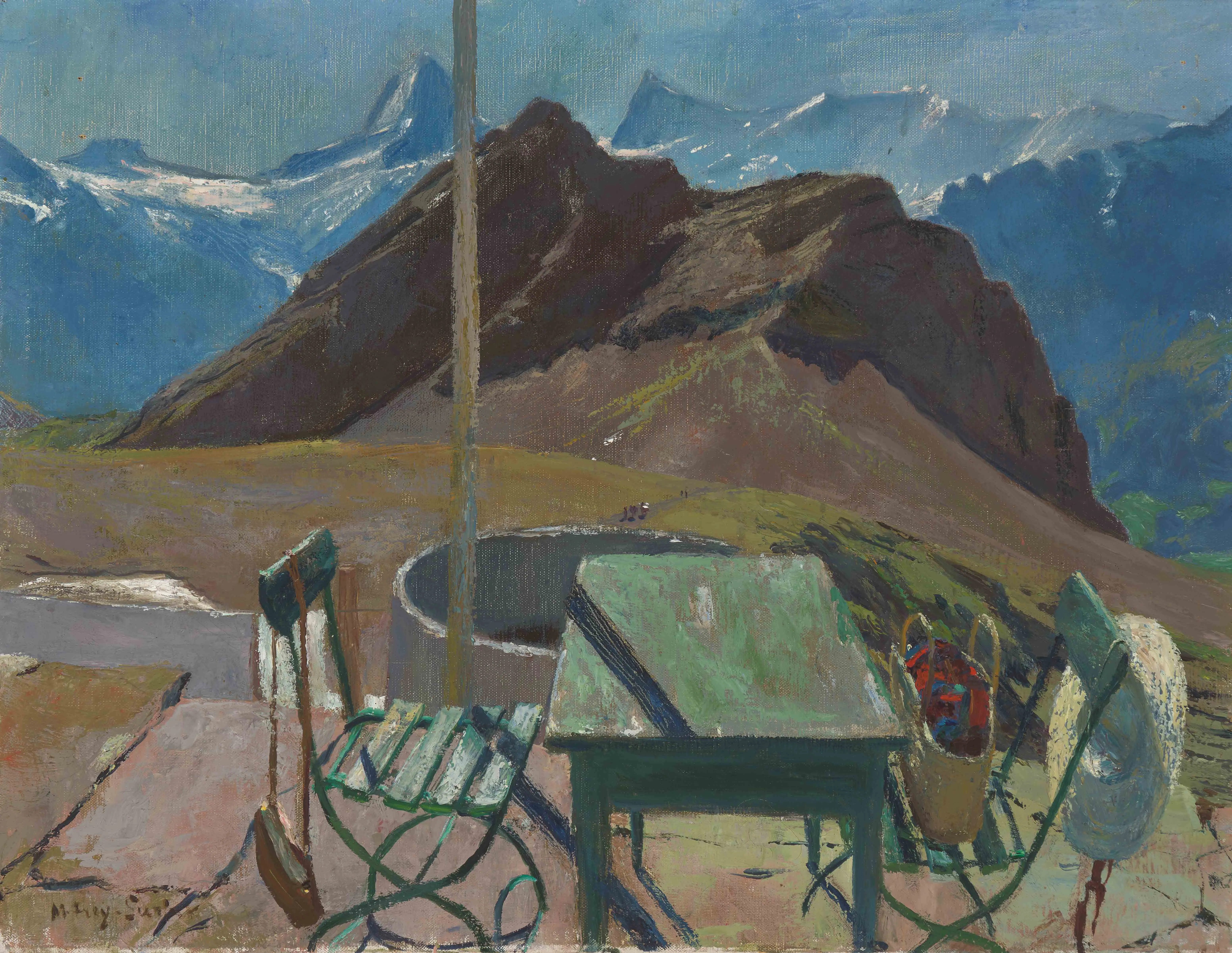
A water barrel peeks out from behind the table on this terrace; a woman’s things occupy the two chairs. Figures on the greening slopes below make their way towards us.
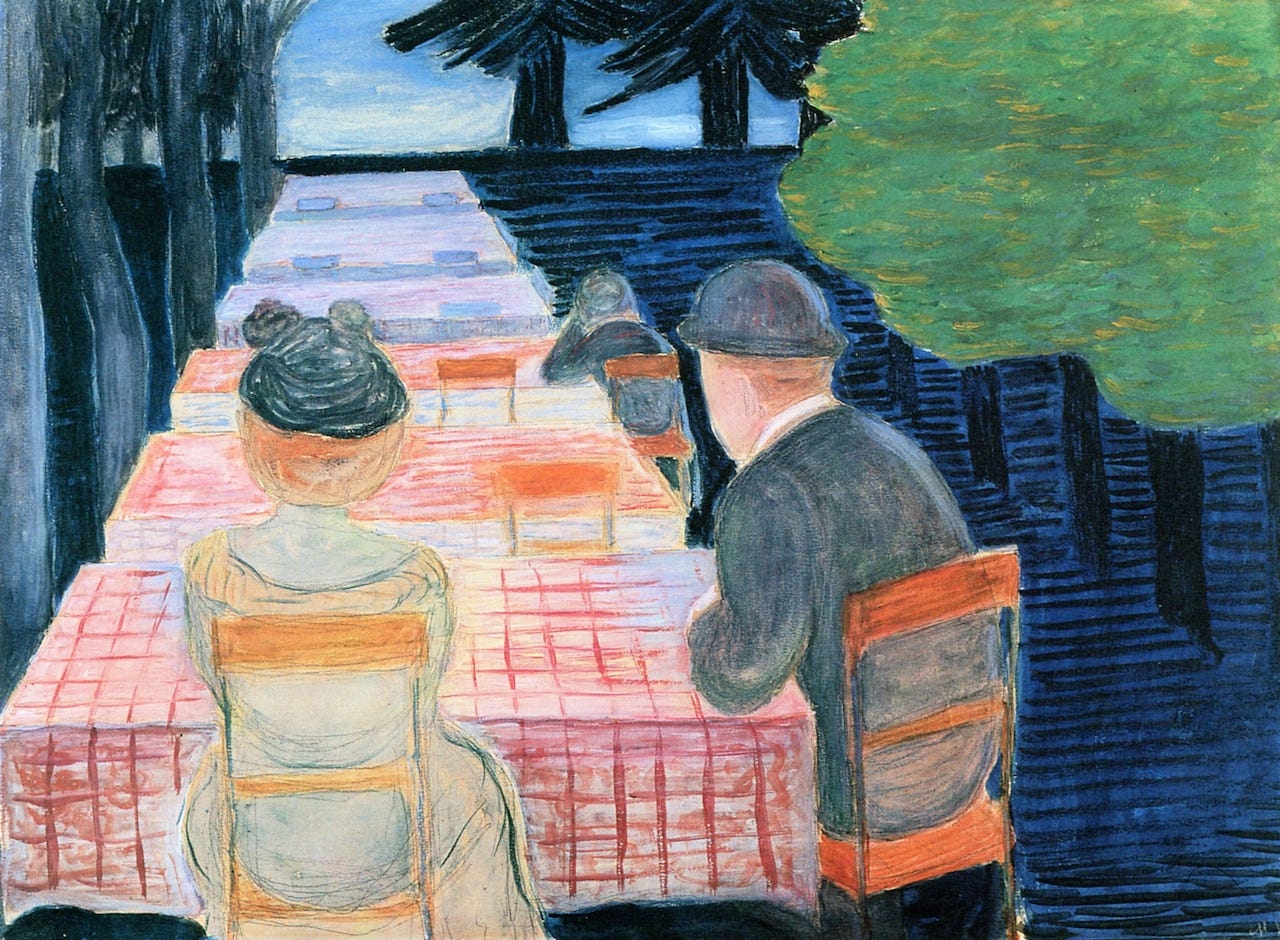
There are seats to spare in Marianne von Werefkin’s Sunday Afternoon (1908). A pair waits at a neat line of tables amid rows of trees. The only other patron sits alone, with head in hand. There appears to be no conversation. Nothing to consume.
I encountered this painting, and some of Werefkin’s own molehill mountains, at her foundation in Ascona. In her twenty years in the town, Werefkin seems to have kept her distance from the balabiott — “naked dancers” — up the hill.
On Monte Verità, the “mountain of truth,” uniformly depressing Sunday afternoons were abandoned for a life of naturism, vegetarianism, feminism and dancing. A vegetabile Cooperative was started in 1900. Of her time in Ticino and on Monte Verità, Ise Gropius wrote to Harald Szeemann, “our foreheads touched the sky — but our bottoms rode third class.“2
Yes, there were downsides. But anarchists, analysts, and Sophie Taeuber-Arp visited, though it was in Zurich — at a show more draped in textiles than the Lorenzetti — that I saw her tablecloth from 1922.
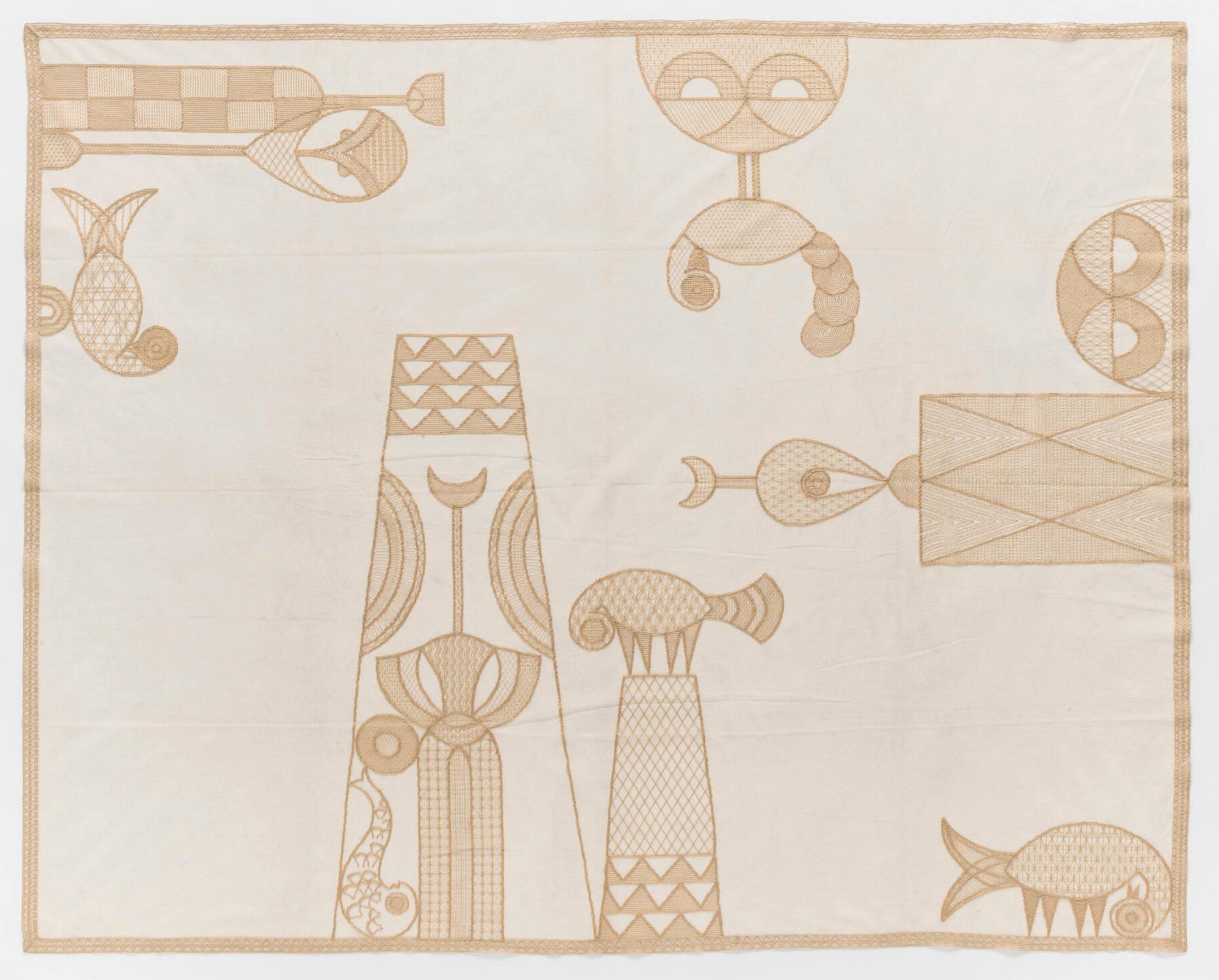
Strange beasts are caught in tulle.
By 1929, the colony on Monte Verità had been abandoned. A baron friend of Werefkin’s built a Bauhaus hotel. I stayed in the last days of June, the one guest not participating in a conference on the subject of cement (“Shaping the Future of Low-Carbon Cement Science”). These scientists didn’t know I was only there for the balabiott.
In the morning I walked through woods grown up over the community’s farm to find the remains of their “light and air baths” (Lichtluftbäder), shallow water basins lying in the grass. A different sort of mountain infrastructure.
Passing through Bremen in August, I went to see Paula Modersohn-Becker’s paintings from Worpswede, another locus of Lebensreform, though flatter.
Modersohn-Becker had a studio in a farmhouse in the village. There she made paintings of the surrounding moor, and of the inhabitants this infertile landscape kept poor.
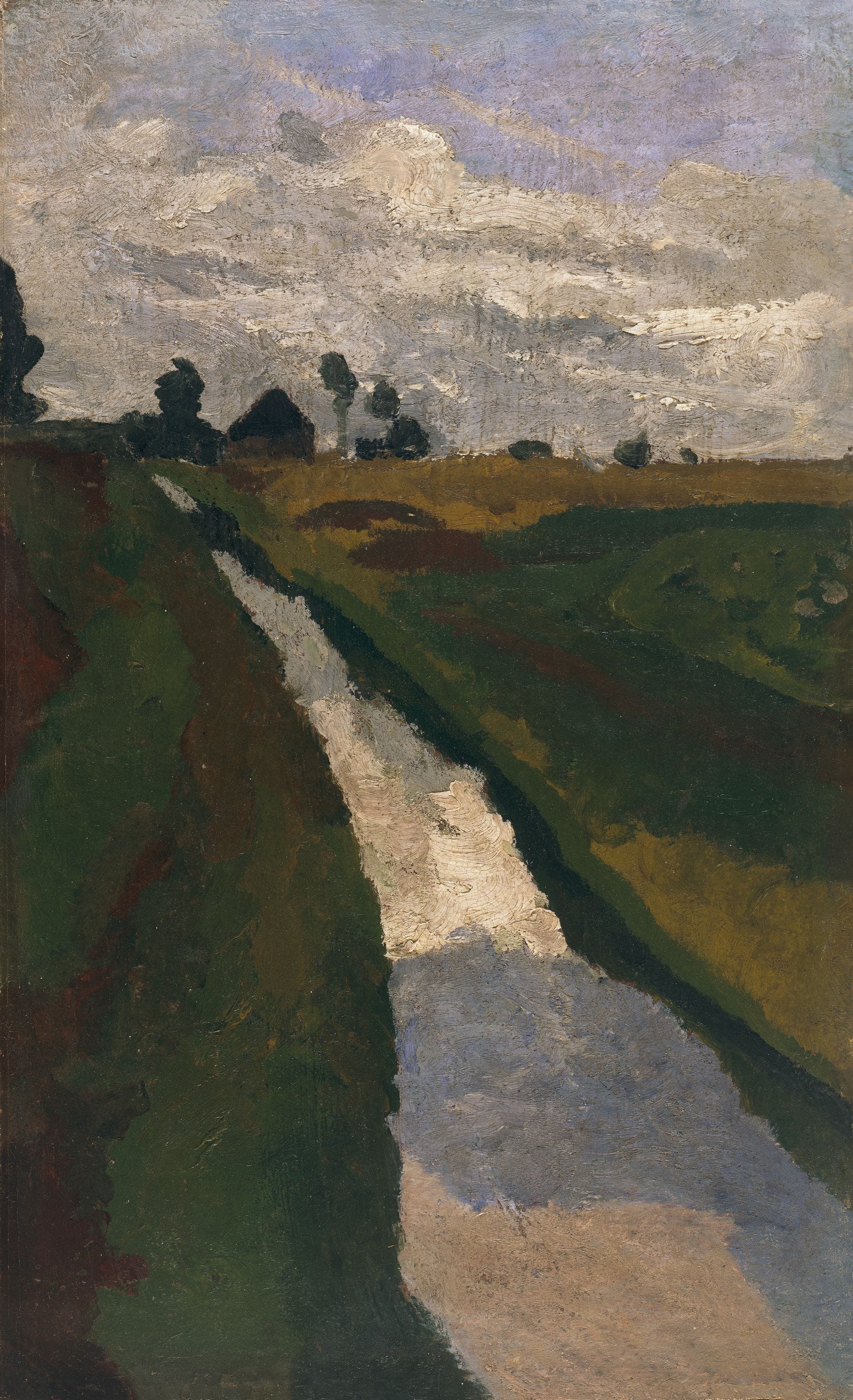
In Moor Canal (ca. 1900) she follows a ditch full of water as it reflects the sky. Despite this drainage, little would grow on the bogs; Modersohn-Becker paid the farmers’ wives and daughters to pose.
She was best at painting herself. In Self-Portrait on Sixth Wedding (Anniversary) Day (1906) she wears the amber necklace now kept as a relic in her museum in Bremen. A plain cloth is gathered around her middle. Both arms frame the bulge of her belly. Many would like her to be pregnant. But it is too early for that.
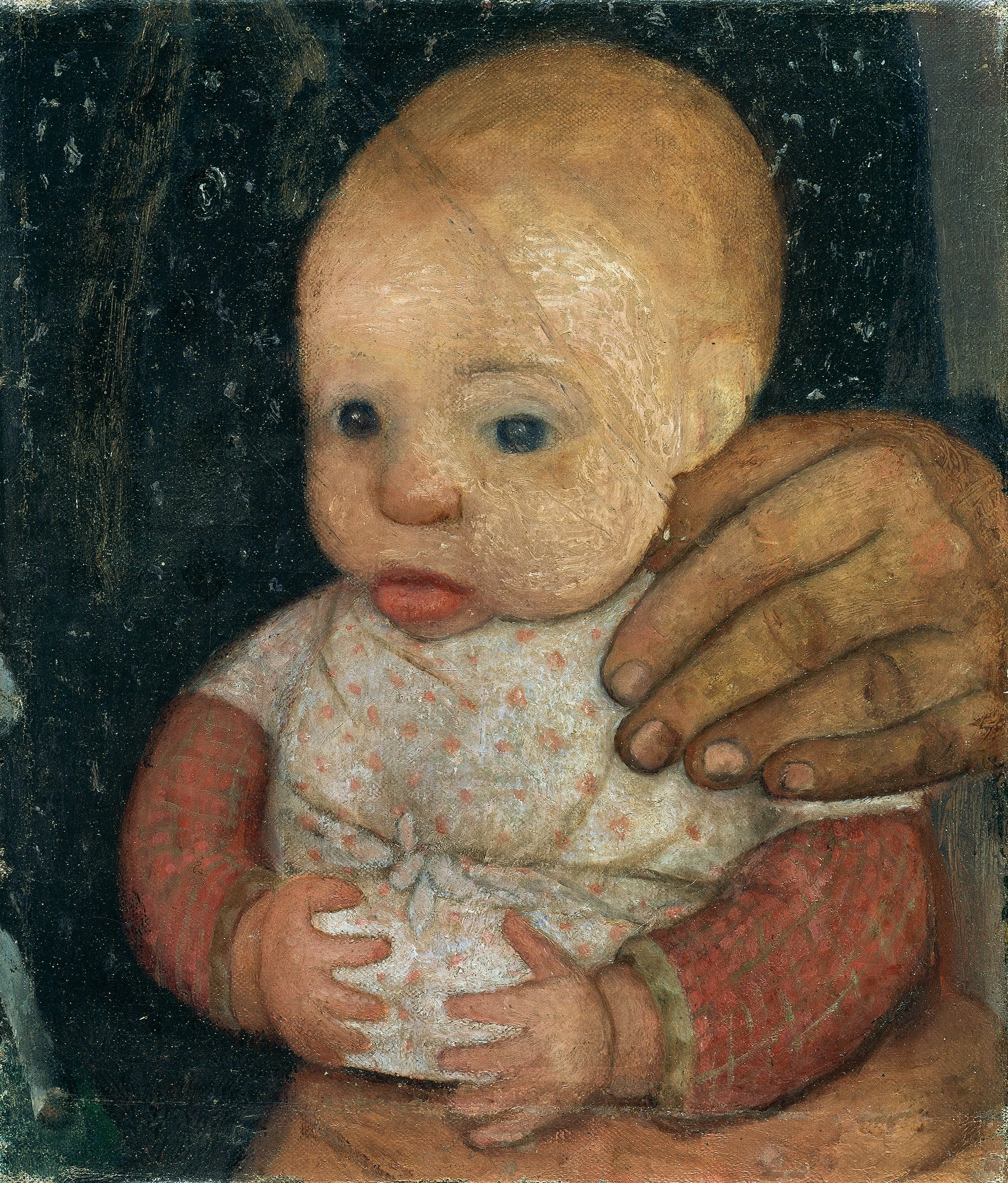
A baby clutches its own protuberance in her Infant with Mother’s Hand (ca. 1903). Modersohn-Becker cut down the canvas, turning the mother who holds the child into background and support. I can’t help but think of the Virgin Mary — the lap in so many pictures.
In Worpswede, Modersohn-Becker got into trouble with the church and painted its walls with flowers to get back into favour — lilies, sunflowers, poppies. Rainer Maria Rilke, whom Modersohn-Becker met in the village, bought the “little child” painting. Her first sale.
In February of 1906, she writes to thank him for the encouragement. She paints his portrait in June. He doesn’t like it.
Modersohn-Becker would die the next year. Rilke’s requiem has been sitting on my desktop all these months. He writes to his friend, “I would like to fling my voice out like a cloth over the fragments of your death, and keep pulling at it until it is torn to pieces.“3 He tells her, as if she doesn’t already know,
“And so you died as women used to die, at home, in your own warm bedroom, the old-fashioned death of women in labor, who try to close themselves again but can’t.”
Loved reading every word of this.
Such a treasure, Beatrice...mesmerizing from the first word!
The small Swiss museums bring back many happy memories when Joseph and I traveled extensively there. The Thunersee and Spiez were quite special to us, as well.